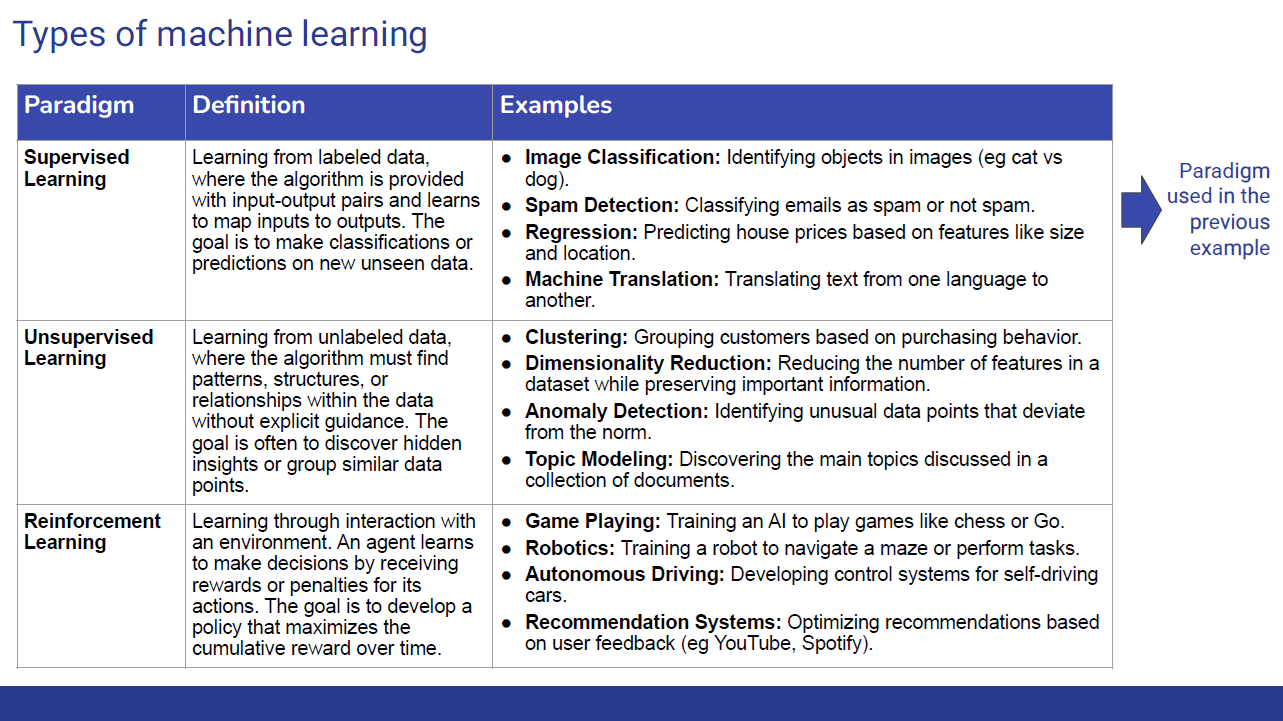
Machine learning is usually divided into three paradigms, and the difference between them is simply what the model learns from.
Supervised learning learns from labeled data — input/output pairs where the right answer is provided. The model’s job is to learn the mapping from input to output well enough to predict new cases, never seen during training. The examples from earlier chapters, such as predicting average income from age, are classic supervised learning: every record in the training set contains the answer observed in the real world (a real person’s age, their income). More generally, tasks like image classification, spam detection, house-price prediction, and machine translation are all supervised.
Unsupervised learning learns from unlabeled data — no answers provided. The model has to find structure on its own: grouping similar things, reducing complexity, spotting anomalies. Clustering customers by purchasing behavior, dimensionality reduction, anomaly detection, and topic modeling all live here. Nobody tells the model what’s “right”; it discovers the patterns and the connections between the records in the training set.
Reinforcement learning learns from interaction. An agent takes actions in an environment and receives rewards or penalties, and over time it learns a policy — a way of acting — that maximizes the reward it collects. This is how AIs learn to play chess or Go, how robots learn to navigate, and how recommendation systems tune themselves to your feedback.
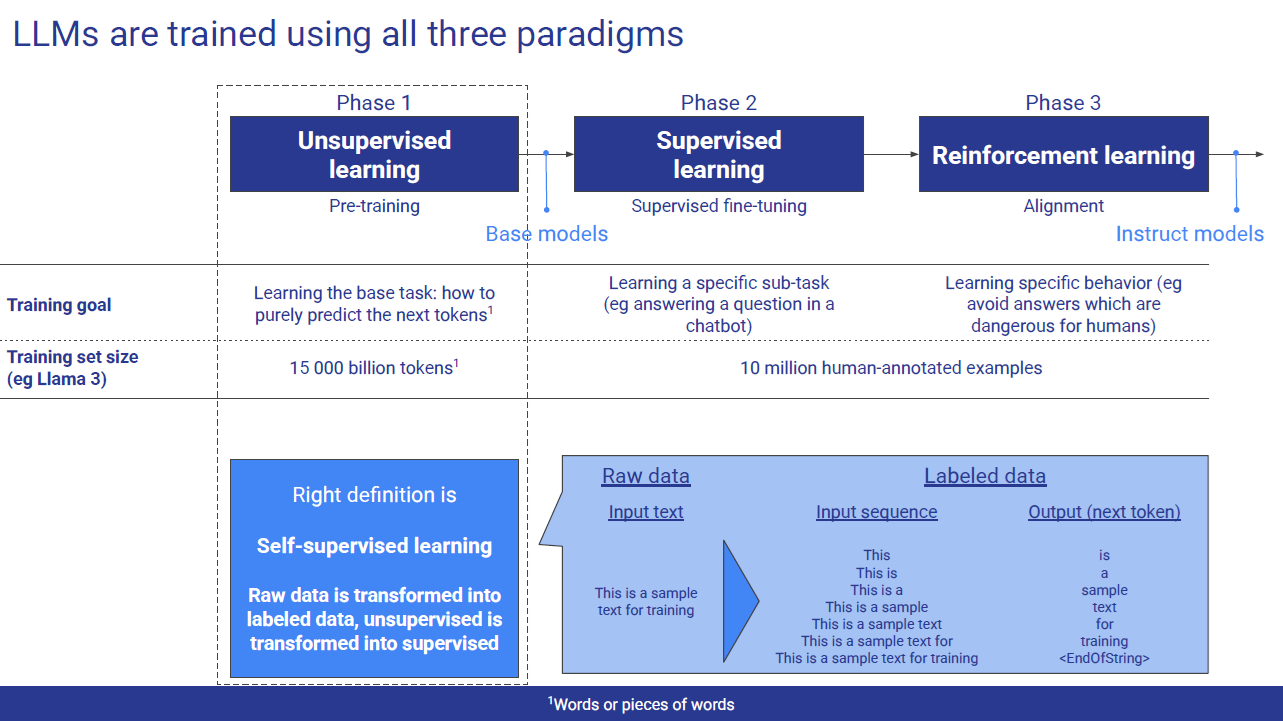
Here’s the part that surprised me, and that ties the whole of Series 1 to what follows: a modern large language model is trained with all three paradigms, in sequence. And as research advances, training schemes are becoming ever more elaborate and opaque, often covered by trade secrecy. In broad terms, the “traditional” training scheme runs as follows.
- Pre-training is self-supervised — a clever form of unsupervised learning. You take raw text and turn it into a supervised task for free: given any sequence sampled from the training texts, the model is trained to predict the word that follows. “This is a sample text” becomes many input→output pairs (“This” → “is”, “This is” → “a”, …). No human labeling required, and yet the model learns the base skill of language across trillions of words.
- Supervised fine-tuning then teaches a specific behavior — how to answer a question or produce a translation — from a smaller set of curated examples.
- Alignment uses reinforcement learning to shape the model’s behavior, rewarding answers that are helpful and safe and penalizing ones that aren’t.
So the three paradigms aren’t rival camps; they’re stages. The same model passes through unsupervised, then supervised, then reinforcement learning on its way from raw text to something you can actually talk to. With that, the fundamentals are in place — and the series turns to the architecture that makes it all work: the neural network.